Sağlık Sektörü Tahsilat Sistemi
Sağlık sektöründe finansal sürdürülebilirlik, etkin bir tahsilat sistemine bağlıdır. Manuel süreçler ve SGK kesintileri ciddi gelir kayıplarına yol açarken, modern bir sağlık sektörü tahsilat sistemi nakit akışını optimize eder.
Financial sustainability in the healthcare sector depends on an effective collections system. While manual processes and SGK (Social Security Institution) deductions lead to significant revenue losses, a modern healthcare collections system optimizes cash flow. These systems secure the financial resilience of institutions by reducing error rates and increasing operational efficiency.
Private healthcare organizations in Turkey are struggling to survive in a complex ecosystem with a weakening financial pulse. Rising costs, shrinking profit margins, and unpredictable economic conditions are forcing executives to be more strategic than ever. In this challenging equation, collections management is no longer just an administrative task; it is the institution's life support system. Even the slightest disruption in these processes can create a chain reaction that threatens operational continuity.
Economic Pressures Weakening the Financial Pulse in Healthcare
Private hospital and clinic administrations are fighting a multi-front war against costs. High inflation continually drives up the costs of medical devices and supplies, disrupting budget discipline. The reimbursement increases made by the SGK are woefully inadequate in the face of this tsunami of costs. Consequently, this situation is melting away profit margins like an iceberg and casting a shadow of uncertainty over the financial future of these institutions.
Furthermore, rising credit costs are making technology investments nearly impossible. Inefficiency in financial processes directly impacts clinical quality. Suppliers who do not receive timely payments may slow down the flow of materials, which can even lead to the postponement of surgeries. In short, poor financial performance triggers a downward spiral of low service quality and dissatisfied staff. Therefore, establishing an effective hospital collections system is a fundamental prerequisite for delivering high-quality care.
What Are the Biggest Challenges in the Collections Process?
The labyrinth of healthcare financing is filled with the constantly changing rules of the SGK and private insurance companies. Financial success will belong to proactive, technology-driven institutions that can navigate this complex maze.
Why Are SGK Audits Increasing?
In recent years, the SGK has tightened its audit mechanisms. It now operates with a much more prescriptive and inquisitive approach. This means that invoices are being examined under a microscope. The penalty for a simple administrative error has tripled in the last three years alone. This increase painfully demonstrates that the luxury of making mistakes has completely vanished for healthcare organizations.
The SGK's current model is based on a principle of "pay first, audit later, and claw it back if you find an error." The institution makes the payment to ensure the continuity of service, but this is no guarantee. Months, or even years later, it conducts detailed audits and reclaims amounts it deems incorrect through deductions and penalties. This practice turns every submitted invoice into a financial risk ready to explode in the future. Therefore, a flawless and defensible billing process is no longer just a procedure; it is an armor that protects the future.
What Risks Do Private Insurers and the Complementary Health Insurance (CHS) Market Hold?
With 4.75 million insured individuals, the Complementary Health Insurance (CHS) market is rapidly growing its slice of the pie. This presents a huge opportunity for hospitals. However, this growth also brings operational complexity.
Now, it is necessary to cope not only with the rules of the SGK but also with those of dozens of different private insurance companies. Each company has its own unique contract, pre-authorization process, and billing codes. This multi-payer environment is far too complex to be managed with manual systems. For this reason, without efficient collection solutions for outpatient clinics and medical centers, it is nearly impossible to emerge profitably from this market.
The MEDULA System
In theory, the SGK's MEDULA system is a significant step toward digitalizing processes. However, the reality on the ground reveals that this digital bridge has some fundamental shortcomings.
The "MEDULA Paradox": How Digitalization Increases Workload
MEDULA operates less like an intelligent audit mechanism and more like a "digital data validation" portal. In other words, it doesn't proactively prevent errors; it merely checks whether the entered data complies with the rules. This approach places the entire responsibility on the user.
This is where the "MEDULA Paradox" comes into play: digitalization has, ironically, increased the manual workload. Checking data taken from the HIS (Hospital Information System) against the complex SUT¹ rules and then manually entering it into MEDULA is a tedious and error-prone process.
But the real problem is the lack of integration. MEDULA doesn't "talk" to your hospital's HIS, accounting, or HR systems. This "silence between systems" is the primary source of financial leakage. For instance, a critical error like issuing an invoice under the name of a doctor who is on leave stems directly from this disconnect. The problem isn't MEDULA itself, but the gaps between the systems.
What Are the Most Common Costly Errors?
SGK invoice deductions are a silent loss, often accepted as a "cost of doing business." Yet, studies indicate that these deductions can amount to 1.72% of the total invoiced value and stem largely from "preventable" errors. With shrinking profit margins, this percentage can determine the difference between profit and loss at the end of the year.
Here are the most frequently encountered and costly errors:
Failure to Obtain Pre-Authorization: Not securing eligibility confirmation before providing a service means your labor and resources are completely wasted, resulting in a 100% revenue loss.
Clinical Coding Errors: The use of incorrect ICD-10 codes or an inadequate discharge summary (epikriz) can lead to the outright rejection of the claim.
Administrative Procedural Errors: Processing a transaction under a physician who is on leave, billing from the wrong specialty, or non-compliance with the SUT¹, which contains thousands of rules, are among the most common reasons for deductions.
Lack of System Integration: When software used by different departments (HR, accounting, medical) doesn't "talk" to each other, it leads to a chain reaction of errors.
What Should a Modern Healthcare Collections System Look Like?
The solution to these complex problems isn't hiring more staff, but making processes smarter. This is where medical collections automation emerges as a strategic imperative. What is needed is not a collection of separate programs, but an integrated platform that manages all financial operations like a nerve center.
An effective healthcare collections software must have the following core components:
Centralized Control Panel: Offers the ability to monitor cash flow from all channels—such as SGK, private insurance, patient payments, and POS—in real-time from a single screen.
Full Integration: Seamlessly "talks" to your existing HIS, ERP, and accounting systems, eliminating manual data entry.
Intelligent Reconciliation Engine: Automatically matches payments received in bank accounts with outstanding invoices. It identifies short payments or deductions within seconds.
Rule-Based Proactive Controls: Ensures errors are eliminated at the source by automatically auditing claims against SUT and private insurance rules before submission.
How to Achieve Digital Transformation in Healthcare Finance
Choosing the right solution from the many healthcare collections systems on the market is critically important. With its integrated and modular solutions, Finrota goes beyond being just a software provider to offer healthcare organizations a holistic financial management ecosystem.
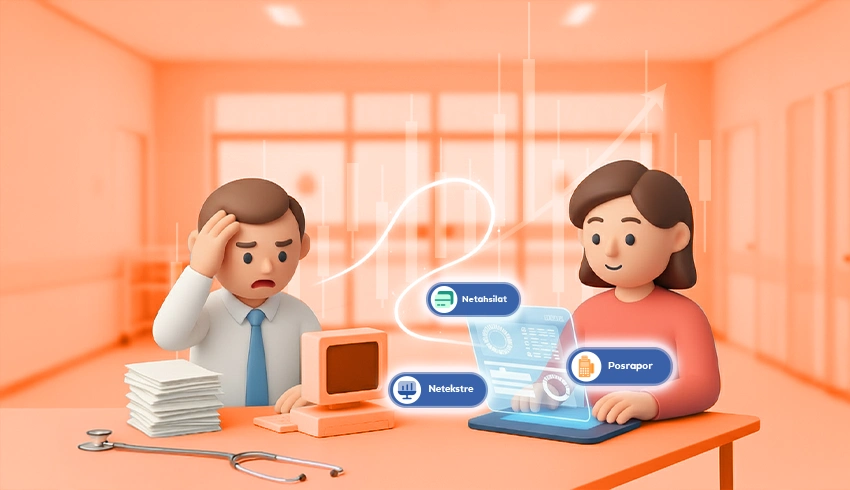
Automated Reconciliation with Netekstre: It reduces the weeks-long SGK and private insurance reconciliation process to minutes. It automatically matches every incoming payment with its corresponding invoice and triggers an immediate alert in case of a deduction. Healthcare companies using this module have been observed to save an average of 720 hours of manual workload annually. This is equivalent to approximately 90 business days for one staff member.
Flexibility in Patient Collections with Netahsilat: It provides virtual POS terminals from all banks in a single panel. It simplifies and accelerates collections by allowing you to send payment links to your patients via SMS or email. Thanks to this flexibility, the collections volume of healthcare companies using the platform has shown an increase over the past year.
Full Control with Posrapor: It consolidates all physical and virtual POS transactions, commissions, and value dates onto a single screen. By automatically transferring this data to your accounting system, it maximizes cash flow predictability and control.
The power of Finrota lies in the seamless integration of these modules with each other and with your existing systems. This structure fundamentally prevents costly errors arising from the disconnect between systems and transforms your finance department from a reactive data entry center into a proactive strategy hub.
Automation is a Strategic Imperative for Financial Resilience
Survival and growth in the healthcare sector no longer depend solely on clinical success, but also on operational excellence. Medical collections automation is not a luxury; it is an undeniable investment in building financial resilience.
The time has come to question the hidden costs and financial risks created by manual workflows. The way to secure the cash flow—the lifeblood of your institution—is by making your processes smarter with the right technology partner, like Finrota. Don't leave your financial future to chance; take control with automation.