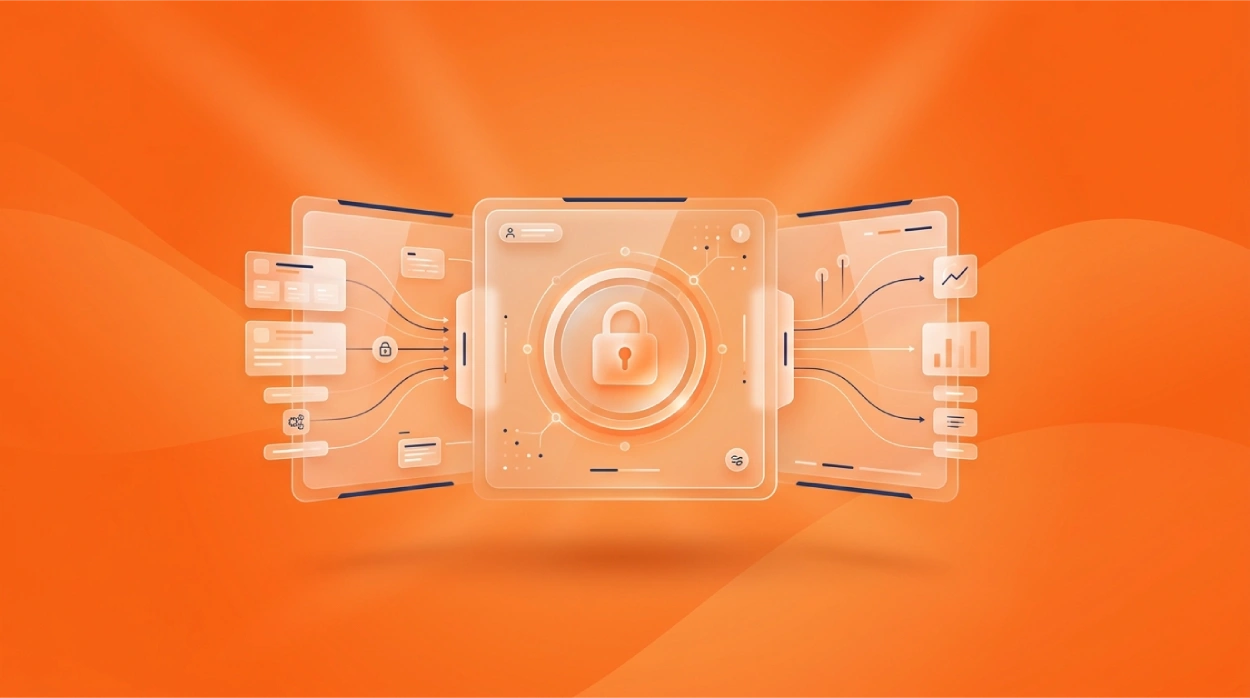
Security in open banking is ensured through the integrated operation of strong authentication, AES-256 data encryption, HSM-based key management, role-based access control, secure API communication via mTLS, and audit trail layers. This architecture is designed to protect sensitive financial data, such as account transactions and balance information.
Why Does Security in Open Banking Require a New Paradigm?
Open banking mandates data sharing while elevating security to the highest level. Unlike traditional closed systems, in an open banking architecture, data is in constant flux between different institutions. This situation requires the concept of financial data security to move beyond network boundaries and focus on the data itself. The Finrota infrastructure serves not merely as an intermediary in this ecosystem but assumes the role of a “safe haven” for data. The designed architecture is founded on the principles of encryption and authorization at every stage of data processing.
The Foundation of Trust in Data Sharing: Identity Verification and Authorization
Strong authentication is the first and most critical step in preventing unauthorized data access in open banking. Within the scope of PSD2 compliance—known as the European open banking security framework—SCA (Strong Customer Authentication) and dynamic link requirements play a significant role in the architecture.
To ensure end-to-end protection of financial data (account transactions, balance information), authentication steps are supported by authorization protocols. The use of OAuth2 and RBAC (Role-Based Access Control) in enterprise systems ensures that users and integrated services can access only data within their authorized scope, thereby reducing the internal and external attack surface.
How Does Application Layer Encryption with AES-256 Work?
In open banking, data encryption processes must begin at the core of the application, independent of the network layer. Finrota implements the industry-standard AES (Advanced Encryption Standard) algorithm using a multi-layered strategy.
The key components of this layered strategy are as follows:
Application Level Encryption: Data is encrypted at the application level before it even reaches the database.
Use of AES-256: A 256-bit key length, which provides military-grade protection, is preferred.
Payload Encryption: Sensitive data (such as JSON objects) received via the API is encrypted before it even leaves the network.
As a result, using modern modes like AES-GCM, not only the confidentiality but also the integrity of the data is mathematically verified.
Protecting Stored Data: At-Rest Encryption and TDE
Encryption applied to financial data while it is stored on servers (at rest) serves as the last line of defense against hardware security breaches. The data remains unreadable even while it is “at rest” on the disk.
TDE (Transparent Data Encryption): Prevents data from being decrypted if database files are physically stolen.
Salt & Hash: In addition to AES, irreversible hash algorithms are used for passwords and credentials. While encryption locks data in a reversible manner, the hashing process creates an irreversible signature of the data—such as passwords—that cannot be converted back to its original form.
Key Management: Why Are KMS, HSM, and Key Rotation Critical?
Just as critical as the encryption algorithm itself is where the “key” that unlocks it is stored. Even the world’s strongest encryption algorithm becomes ineffective if key management is weak.
In an enterprise security infrastructure, keys must be managed according to the following principles:
HSM (Hardware Security Module): Keys are generated and stored in physical security modules, not in software. This physically isolates the keys from digital breaches.
KMS (Key Management Service): The entire key lifecycle is managed through a centralized service.
Key Rotation: Automatically renewing encryption keys at set intervals minimizes the impact of a potential breach.
How Is API Data Transfer Secured with TLS 1.3 and mTLS?
Data transfer security refers to the process of protecting sensitive financial information as it is transmitted over the internet. The protection provided while data flows from one point to another (during API calls) forms the foundation of communication security.
TLS 1.3 Protocol: Ensures the use of the most up-to-date encryption tunnels during data transfer.
mTLS (Mutual TLS): A mutual trust relationship is established where not only the server but also the client (the bank or TPP) authenticates itself using a certificate.
This mutual authentication structure technically prevents Man-in-the-Middle (MITM) attacks and establishes a high level of security in API communication.
What Does the Zero Trust Model Change in Open Banking?
In the Zero Trust model, no network or user is considered secure by default; encryption layers are active for every transaction. This philosophy means that even a request originating from an internal IP address must be subject to continuous verification and the principle of least privilege.
It is also important for corporate decision-makers that such a strict authentication process does not consume system resources. Finrota aims to ensure that high-security layers do not cause latency in system performance by utilizing AES hardware acceleration (AES-NI) to maintain the balance between performance and security.